

 While walking in the Notre-Dame-De-Grace area of Montreal on a particularly cold winter night in January of 2007, I looked up and noticed a massive structure spanning most of the block. Noting the intersections of Sherbrooke and Old Orchard, I realized this must be the Egyptian theatre a friend of mine had just mentioned.
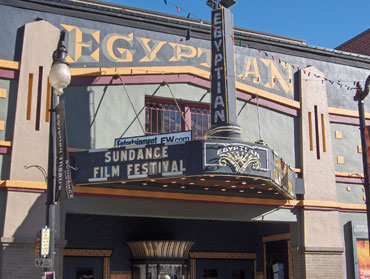
 The Egyptian-themed Empress Theatre opened its doors on May 19, 1928. It was designed by Alcide Chausse, a local architect who’d designed a number of churches and convents on and off the island of Montreal. At 1350 seats, it was not the first theatre of its kind, but the only one in Canada; Sid Graumann’s Egyptian Theatre in Hollywood was built in 1922, and a half-dozen or so appeared throughout the 1920s. A few of them still operate today, most notably the one in Park City, Utah, which serves as one of the primary venues for the Sundance Film Festival.
The atmosphere of the building was not merely an external matter, as its internal walls were the court of an Egyptian palace. The ceiling beneath the balcony and the lower walls were finished in rough plaster and were ornamented in scenes copied from old temples and hand-painted with rich blues, reds and silver and gold. Up on both sides of the stage was a larger than life figure of an Egyptian princess, carrying a vase which she tipped towards a splashing fountain. Even the then-common asbestos curtain had been painted to continue the illusion of being in an outdoor courtyard.
The construction of the Empress emphasized all that was modern in late-1920s theatre design, being perfectly ventilated and fireproof throughout. The latter was of utmost importance to Montreal theatre goers in 1928. The previous year, seventy-eight children were trampled to death after a fire broke out during at a matinee performance at the Laurier Palace Theatre on Ste-Catherine St. The majority of the eight hundred children in attendance that afternoon escaped without injury, but the unfortunate souls caught in a stairwell were trapped when the fire exit was blocked and inescapable. It is perhaps without irony that the former incarnation of Confederation Amusements, who owned the Empress, had also owned the Laurier Palace.
There were other hits playing throughout the city, such as Ramona with Dolores Del Rio at The Palace, and Cecil B. De Mille’s King of Kings at The Princess. The latter was a massive spectacle of the day, with a full touring orchestra playing the film’s score and a live stage show featuring scenes from the film. It was an enormous production, which was reflected in the evening performance’s $1.00 ticket price. It made the Empress Theatre’s 25c admission seem quite modest. With that in mind, a young man wanting to impress his date that evening might have stepped into the Eaton Department store on Victoria St. and chosen a new straw hat for the occasion. Not a bad deal for a couple of bucks.
 The now bygone Sherbrooke streetcar must have been packed that evening as hundreds of people were turned away on opening night. All the publicity for the Empress emphasized that this new spectacular theatre would offer both motion pictures and Vaudeville acts. That practice would last until the end of the 1930s, as the permanency of talking pictures would slowly sound the death knell for Vaudeville. The programme for the evening, which was emceed by Alderman J.E. Lyall, included Jerry Lear and Girls in song and dance, Libby and Gardiner, bicycle riders, and Frank Hamilton and Company in a number of Vaudeville acts. The orchestra was conducted by the Montreal-famous J.J. Goulet. The feature that evening was the Montreal premiere of Wild Geese, a drama of farm life featuring Goldwyn star Belle Bennett and future Technicolor star Russell Simpson. Adapted from a popular novel of the day, Wild Geese was the story of a woman who defied her husband for the sake of her children’s happiness. Canada was in a boom period at the time, so perhaps seeing a hard-hitting drama didn’t hit home the way it would a few years later.
The Empress remained a popular movie-going spot in Westmount and NDG, despite others popping up throughout the 1930s like the Monkland (1930) and the Snowdon (1937), which served many patrons living along Cote St-Luc and the northern end of NDG. Cinema Treasures claims that in 1962, The Empress stopped showing movies altogether and became a popular cabaret named the Royal Follies. More changes came along in 1968, as the theatre was divided along the balcony and became the Cinema V. It was briefly known as “The Home of Blue Movies” in 1974, but became a popular repertory theatre the next year, and remained so until it closed in 1992. That year, a fire had damaged the theatre beyond feasible repair.
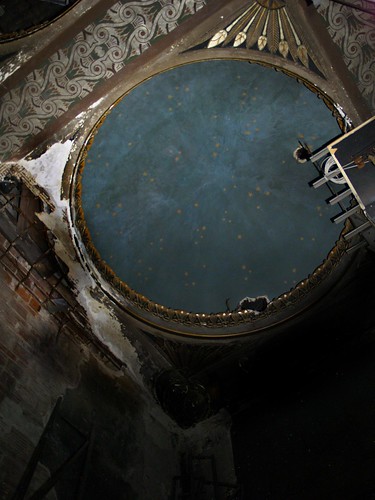
All is not lost, however, as a few years ago, a group known as The Empress Cultural Centre paid the city of Montreal back-taxes on the building and now holds a 60 year lease with plans of eventually re-opening the building as a major cultural centre for NDG. Plans were set to have the centre open by 2008, but it doesn’t look as though it will be possible due to the lack of required funding, which currently stands at approximately $8.5mil. When I walked by on a warmer day about a month later, I could see mask-covered workers carrying debris out from a very dusty and moldy-smelling interior. Sadly, all I could see was that the interior was completely gutted, confirming another account I’d read about the sad state of the building. Recently, an urban explorer in Montreal got into the building and took some interesting photos, including one which appears to showcase the blue ceiling mentioned above. Perhaps with some generous donations and more community input, The Empress will some day stage performances again and maybe even have a classic film grace its marquee.
The Runnymede and The Empress were not the only theatres in Canada to boast the atmospheric style. In Halifax, on the very site where Lord Cornwallis founded the city some two centuries before, stood the elegant Capitol Theatre. Not an atmospheric theatre in the strictest sense, but its entrance and lobby favoured the look of a medieval hall, complete with decorative suits of armour and a chain-linked draw bridge leading into the main auditorium. Four other atmospherics shared the Capitol name: The Capitol in Cornwall, Ontario was a sister theatre to the Runnymede, and was unfortunately demolished in the late 1990s. Both Regina and Saskatoon had one, and the latter, built in 1929 and demolished in 1979 was an atmospheric. The Capitol in Port Hope transports you back to a medieval town, and along with the Granada Theatre in Sherbrooke, it is one of the few Atmospherics that still exists in Canada. The Capitol is one of the two sites of the annual Marie Dressler Foundation’s Annual Vintage Film Festival in Port Hope and Cobourg.
Saskatoon has one surviving atmospheric, the Roxy, whose interior looks like a Spanish Courtyard.
It is nice to know that some of these theatres still exist as concert venues for a variety of performing arts. You could say that the Sci-Fi look of some of the major Cineplex Colossus and Silver City locations is a 21st century update to the Atmospheric genre, but I’d like to think the style remains somewhere in the distant past. Besides, these modern places seem to exude something other than atmosphere.
– Sources: Montreal Gazette; thanks to Tom Hutchinson of Magic Lantern Cinemas for providing some information.
 veilletteinto.com

.jpg)
Hello,
This is a message for Eric Veillette.
I am the Empress Cultural Centre’s P roject Coordinator. If you would like more information or would like to visit the theatre please give me a call at 514-481-6288 or email at empresscentre@gmail.com
I really enjoyed your article.
We have submitted a request for funds to the provincial and federal governments and we are eagerly waiting for a reply. So far, the feedback is good.
Christiane
LikeLike
Thank you for sharing your perspectives and knowledge. My fingers are crossed that the Empress can be saved and re-used. You might find the Theatre Historical Society of American and the League of Historic American Theatres to be an interesting and helpful resource.
LikeLike
The Patricia Theatre in Powell River BC is also an atmospheric theatre.
http://www.patriciatheatre.com
LikeLike
Would it be possible for you to put a link to our website http://www.empresscentre.org on your site?
thanks,
Christiane Loiselle
Project coordinator
Empress Cultural Centre
LikeLike
Very comprehensive post Eric. I hope the theatre can be saved and re-opened.
LikeLike
Hey.
I am a Montreal filmmaker who is working on a short documentary about the Empress Theatre.
Although the doc will only be released in the spring of 2011 (and I will be sure to notify), I have a little preview available.
A local NDG musician, Scott MacLeod, composed the song “Empress Blue” to recount the history and multiple uses of the building. This song acts as the thread to the documentary, interspersed with interviews.
I shot a music video for his song and it was all shot inside the abandoned theatre.
You can watch it here if you like: http://www.bisfilms.com/blog/?p=846
I also wanted to thank you for your awesome post about the building. It was one of the first pages I found when looking for information about the building and was extremely helpful.
Cheers
LikeLike
Emmanuel,
Glad the article was helpful. Let me know when your documentary is ready!
Cheers,
Eric
LikeLike
are there any pics of the interior of the empress
LikeLike
Robert,
I don’t have any, but I’ve seen some in the archives at the Cinematheque Quebecoise.
Eric
LikeLike
The Columbia theatre in New Westminster (1927) was another atmospheric theatre with Spanish Moor style. It was recently renovated into a cabaret style theatre which allow for many different events and functions. It is also one of few heritage theatres in private ownership which requires innovation and financial sustainability.
LikeLike