
Starring Boris Karloff, Allen Swift and Phyllis Tiller | Directed by Jules Bass | Written by Len Korobkin and Harvey Kurtzman | Maple

In 1943, Universal started a trend by teaming up two of its most popular monsters in Frankenstein Meets the Wolf-Man. Throughout the rest of the decade, the studio would successfully pair classic characters in other films, culminating with Abbott & Costello Meet Frankenstein (1948), one of the best horror-comedies ever made. But the monsters wouldn’t reunite again for nearly two decades, when animation giant Rankin/Bass released Mad Monster Party.
Animated in the stop-motion marionette style of Rankin/Bass classics such as Rudolph, the Red-Nosed Reindeer and Frosty the Snowman, it’s set in the unmistakable, colourful world of the company’s other films. Years after discovering the secret of life, Baron Boris von Frankenstein (Boris Karloff), has achieved the secret of destruction. With this accomplishment, he plans to throw a big party and then retire, leaving his journals and laboratory to his awkward nephew, Felix Flanken (Allen Swift who voice many character in the film). Unfortunately, the Baron’s lovely red-headed assistant, Francesca, doesn’t agree with his choice, and with the help of the party guests (which include Dracula, Dr. Jekyll and Mr. Hyde, The Hunchback, The Creature from the Black Lagoon, the Monster, his mate and the Invisible Man), she schemes to get rid of Felix by whatever means necessary.
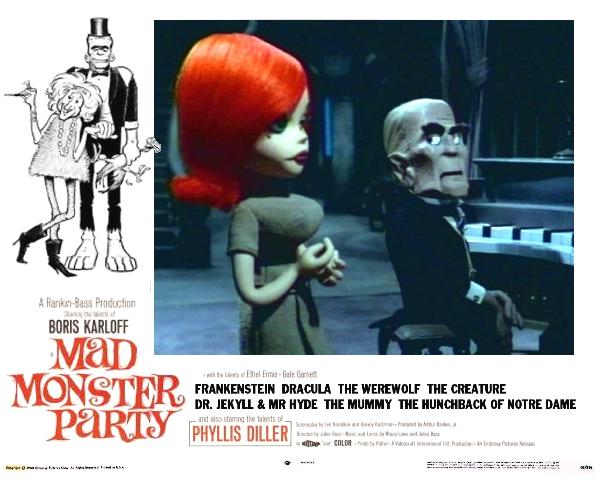
The puns are plentiful, country of writers Len Korobkin and MAD Magazine publisher Harvey Kurtzman, who came to the project late, despite the fact that his trades one-liners are ever-present throughout. (“Quoth the raven, nevermore,” says Frankenstein, as he demonstrates on an unsuspecting bird.) Forrest J. Ackerman was also reported to have lent a hand with the script, and although he receives no screen credit, his name has graced the covers of numerous DVD editions, including this one.
Released several times by Anchor Bay over the past decade, this new reissue from Maple includes three featurettes detailing the music, the stop-motion animation and its enduring status as a cult classic, with Groovy Ghouls: The Making of Mad Monster Party new for this edition. It features an insightful interview with legendary voice actor Swift, who modelled many od the monsters’ voices on classic actors: Felix Flanken is a riff on Jimmy Stewart, the Invisible Man is aping British character actor Sydney Greenstreet (The Maltese Falcon, Casablanca) and Yetch, Frankenstein’s hunchback assistant, channels Peter Lorre, who was still well known to horror fans at the time due to his appearance in Roger Corman’s films.
Mad Monster Party’s influence is indisputable. Monsters getting together and grooving down with a few good tunes would be revisited a few years later in Filmation’s animated Groocy Goolies; Dracula, with his monocle and pointy nose, may have inspired Jim Henson’s studios when creating The Count for Sesame Street; the curvy, busty Francesca serves as a link between the breathy cigarette fire from Tex Avery’s MGM cartoons and Jessica Rabbit; and, of course, Tim Burton’s A Nightmare Before Christmas is a direct descendant of the film.

So why haven’t generations of children since the 1960s been exposed to Mad Monster Party on TV while gearing up for Halloween? The aforementioned Rankin/Bass holiday Christmas specials have long been television programming staples, so why was Mad Monster Party so obscure for so long. This is something that could have been discussed in the featurette. Instead, no one mentions that the film failed at the box office and was then buried by the studio, rarely appearing on television and seldom gracing video store shelves in the early days of VHS. The film’s initial failure has been chalked up to bad timing, and indeed, it may have been a sign that as the 1960s were winding down wider audiences weren’t as interested in classic Universal Monster characters. The film might also seem a little dated to younger generations, with its Goldfinger-inspired opening theme song, references to classic Hollywood, and yes, Phyllis Diller — who appears as the Monster’s mate. But it’s still a fun, music-driven, nostalgia-drenched film from top-notch animators that will bring out the monster kid in all of us.
This article was originally published in Rue Morgue Magazine #96 (2009)
 veilletteinto.com